How Much Does WordPress SEO Cost? 2026 Pricing Guide
Published: 16 Aug 2026
WordPress SEO can cost $0 for DIY SEO, $300–$1,500+ for one-time projects, $500–$5,000+ per month for ongoing SEO, and $5,000+ per month for larger or highly competitive campaigns. For many small businesses, $500–$1,500 per month is a practical starting range for ongoing professional SEO.
The actual price depends on your website size, competition, technical condition, content requirements, target market, and how much work the provider will implement.
From my experience working with WordPress websites and SEO, the biggest pricing differences usually come from scope rather than WordPress itself. A small business website with a clean structure may need focused on-page and technical work, while a larger WordPress or WooCommerce website can require much more time for indexing, internal linking, product structures, performance, content gaps, and technical fixes.
There is no single WordPress SEO price that applies to every website. A $500 package can be appropriate for one site and inadequate for another, depending on what the provider is actually expected to do.
In this guide, you’ll learn how WordPress SEO is priced, what different budgets can realistically cover, which factors increase costs, and how to compare SEO quotes before hiring a provider.
A Practical WordPress SEO Cost Perspective
From my experience working with WordPress websites and SEO, the platform itself is rarely what makes an SEO campaign expensive. The bigger variables are the site’s size, technical condition, competition, content requirements, and how much implementation the provider is expected to handle.
A small business website with a clean structure may need focused on-page and technical work. A larger WordPress or WooCommerce website can require much more time because of indexing issues, internal linking, product and category structures, performance problems, content gaps, or complex URLs.
That’s why I recommend looking at the actual deliverables before comparing SEO quotes. A lower-priced package can make sense when the scope is small, while a higher quote may be reasonable when it includes technical implementation, content, authority building, and ongoing strategy.
WordPress SEO Cost at a Glance
This table gives you a quick view of the main WordPress SEO pricing models, from DIY optimization to ongoing professional campaigns. Your actual cost will depend on the size, complexity, competition, and scope of work required for your website.
| SEO option | Typical cost | Best suited for |
| DIY SEO | $0–$150+/year | Small websites, bloggers and beginners |
| SEO plugins/tools | $0–$150+/year | Website owners managing SEO themselves |
| Hourly consulting | Varies | Specific problems, strategy and training |
| One-time SEO project | $300–$1,500+ | Audits, setup and defined fixes |
| Small-business SEO | $500–$1,500/month | Small businesses and local websites |
| Growth-focused SEO | $1,500–$5,000/month | Competitive businesses and larger sites |
| Advanced/enterprise SEO | $5,000+/month | Large ecommerce, national and international websites |
Don’t treat the table as a rate card. SEO providers package their services differently, so scope is more meaningful than the headline price.
How Much Does WordPress SEO Cost Per Month?
Monthly retainers are one of the most common ways businesses pay for ongoing SEO. Ahrefs found that 78.2% of surveyed SEO providers charge a monthly retainer for at least some of their services. Its survey also found that $501–$1,000 was the most common monthly retainer range, although prices varied considerably by provider and market.
Around $500–$1,500 per month
This can be a practical range for a small business with a focused website and moderate competition.
Depending on the service provider, the package might come with:
- Keyword research
- On-page optimization
- Technical monitoring
- Internal linking
- Content recommendations
- Local SEO
- Limited content production
- Basic link-building work
- Monthly reporting
Not every package includes all of these, so check the scope before signing.
Around $1,500–$5,000 per month
A larger budget can support a broader campaign involving:
- Technical SEO implementation
- Regular content production
- Competitor analysis
- Internal linking at scale
- Link acquisition
- Digital PR
- National SEO
- Ecommerce SEO
- Conversion-focused optimization
- Detailed performance analysis
$5,000+ per month
This level becomes more relevant for websites with:
- Hundreds or thousands of pages
- Large product catalogues
- Multiple locations
- International markets
- Strong national competitors
- Complex technical requirements
- Large content programs
- Several specialists working together
A larger SEO budget does not guarantee faster rankings. It allows more resources to be assigned to the campaign, but search competition, website history, content quality, technical health, and authority still affect the outcome.
WordPress SEO Cost by Pricing Model
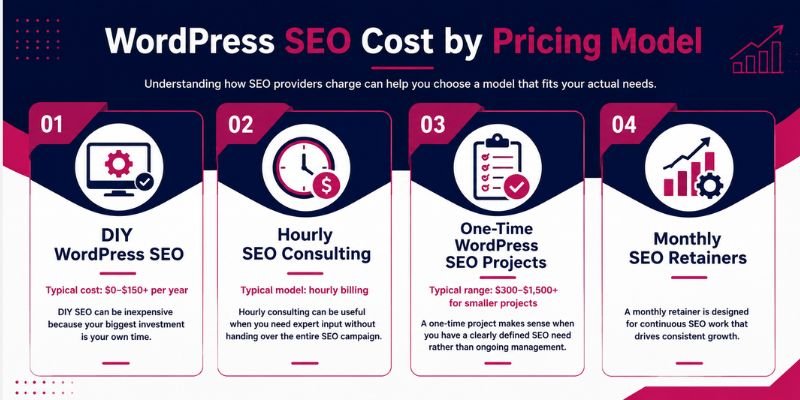
Understanding how SEO providers charge can help you choose a model that fits your actual needs.
1. DIY WordPress SEO
Typical cost: $0–$150+ per year
DIY SEO can be inexpensive because your biggest investment is your own time.
You can handle many foundational tasks with free tools, including:
- Google Search Console monitoring
- Basic keyword research
- Title and meta description optimization
- Internal linking
- Image optimization
- Content updates
- Sitemap monitoring
- Basic technical checks
You may also choose a paid SEO plugin or software.
For example, SEOPress currently offers a free version, while its Pro license starts at $49 per year for one site. Its current Pro offering includes features such as site audits, local SEO, WooCommerce SEO, schema, sitemaps and redirect management.
The important distinction is:
Buying an SEO plugin is not the same as buying SEO services.
The plugin gives you tools. You still need to decide which pages to optimize, which searches to target, which content to create, and which technical issues actually matter.
DIY SEO can work well when:
- Your website is relatively small
- Competition is limited
- You have time to learn SEO
- You can make WordPress changes yourself
- Organic search isn’t yet your primary customer-acquisition channel
2. Hourly SEO Consulting
Typical model: hourly billing
Hourly consulting can be useful when you need expert input without handing over the entire SEO campaign.
You might hire a consultant to:
- Audit a website
- Review Google Search Console
- Diagnose an indexing issue
- Review keyword targeting
- Analyze a website migration
- Review a technical SEO problem
- Train your team
- Build an SEO roadmap
Ahrefs found $75–$100 per hour to be the most common hourly range among its surveyed SEO providers, while 47% charged between $75 and $200 per hour.
This model is especially practical when you already have a developer, writer or marketer who can implement the recommendations.
3. One-Time WordPress SEO Projects
Typical range: $300–$1,500+ for smaller projects
A one-time project makes sense when you have a clearly defined SEO need rather than a need for ongoing management.
Examples include:
- SEO audits
- Technical SEO audits
- WordPress SEO setup
- Redirect cleanup
- Indexing fixes
- Schema implementation
- Internal linking improvements
- On-page optimization
- Website migration support
There is a major difference between an audit-only project and an audit-plus-implementation project.
An audit tells you what needs attention.
Implementation means someone actually makes the changes, tests them and checks the result.
When you pay, always ask which one you are getting.
4. Monthly SEO Retainers
A monthly retainer is designed for continuous SEO work.
Depending on the provider, it can include:
- Keyword research
- Content planning
- Existing-page optimization
- New content
- Technical SEO
- Internal linking
- Link acquisition
- Local SEO
- Competitor research
- Reporting
- Ongoing strategy
Monthly SEO makes more sense when the website needs continuous work instead of a single cleanup.
WordPress SEO Cost by Budget
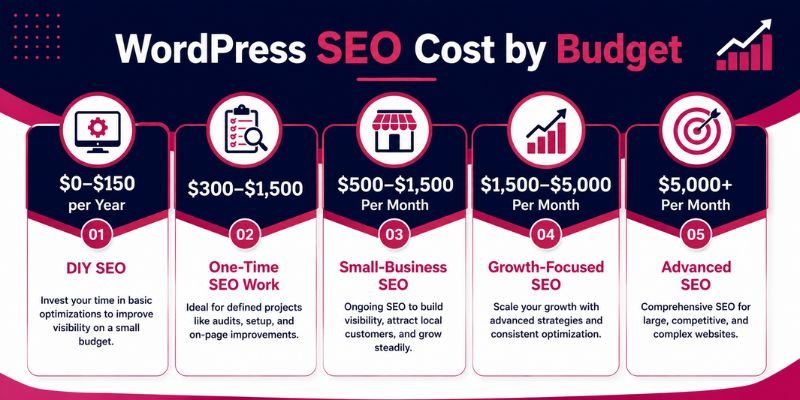
The more useful question isn’t only:
“How much does WordPress SEO cost?”
It’s:
“What can I realistically expect for my budget?”
$0–$150 per Year: DIY SEO
At this level, you’re mainly investing your own time.
You can work on:
- Titles
- Meta descriptions
- Internal links
- Content optimization
- Image alt text
- Basic technical checks
- Search Console monitoring
- Sitemap monitoring
This can be enough for a small website in a low-competition niche.
The trade-off is the learning curve and the time required to implement and monitor the work.
$300–$1,500: One-Time SEO Work
This budget can cover a defined project such as:
- SEO audit
- Technical audit
- Keyword research
- Initial WordPress SEO setup
- On-page optimization
- Redirect cleanup
- SEO roadmap
The scope matters more than the number.
A $500 audit that produces recommendations is a different service from a $500 project that includes implementing those recommendations.
$500–$1,500 Per Month: Small-Business SEO
This can be a practical starting range for an ongoing SEO campaign when the website is relatively small, and competition is moderate.
Possible work includes:
- Keyword research
- Priority-page optimization
- Technical monitoring
- Local SEO
- Internal linking
- Content recommendations
- Limited content creation
- Basic authority building
- Monthly reporting
Ask exactly what the provider will do each month rather than assuming the entire list is included.
$1,500–$5,000 Per Month: Growth-Focused SEO
At this level, a campaign can support more extensive work:
- Technical SEO implementation
- Content strategy
- Regular content production
- Competitor research
- Internal linking at scale
- Link acquisition
- Digital PR
- Ecommerce SEO
- Conversion tracking
- Ongoing testing
This range becomes more relevant as the website and search market become more competitive.
$5,000+ Per Month: Advanced SEO
Higher budgets can be appropriate for:
- Large ecommerce stores
- National brands
- International websites
- Multi-location businesses
- Large publishers
- Complex technical platforms
The campaign may involve multiple specialists, large-scale content production, technical implementation, analytics, digital PR and authority building.
Price alone doesn’t define quality. The scope and execution matter.
How Much Does Each WordPress SEO Service Cost?
Another way to understand SEO pricing is to look at the individual work involved.
| SEO service | Common pricing model | What you’re paying for |
| SEO audit | One-time project | Website analysis, findings and priorities |
| Keyword research | Project or package | Keyword discovery and page mapping |
| On-page SEO | Per page or package | Titles, headings, content and internal links |
| Technical SEO | Project or retainer | Crawling, indexing, redirects, schema and technical issues |
| Content optimization | Per page/project | Updating existing content |
| Content creation | Per article/package | Research, writing, editing and optimization |
| Link building | Campaign or retainer | Outreach and relevant link acquisition |
| Local SEO | Monthly | Local visibility and location-focused optimization |
| WooCommerce SEO | Project or retainer | Product, category and ecommerce optimization |
| SEO consulting | Hourly | Strategy, advice and troubleshooting |
Many providers bundle several services into one monthly package.
That’s why a $1,000 monthly package from one provider can look completely different from a $1,000 package from another.
What Does a WordPress SEO Package Include?
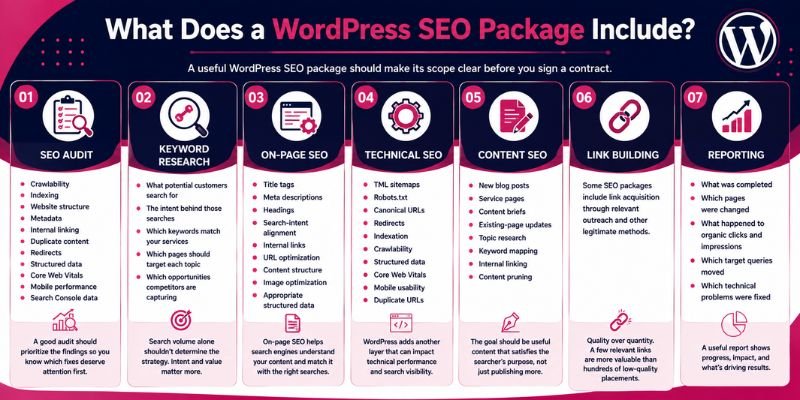
A useful WordPress SEO package should make its scope clear before you sign a contract.
SEO Audit
An audit may examine:
- Crawlability
- Indexing
- Website structure
- Metadata
- Internal linking
- Duplicate content
- Redirects
- Structured data
- Core Web Vitals
- Mobile performance
- Search Console data
A good audit should prioritize the findings so you know which fixes deserve attention first.
Keyword Research
Keyword research helps identify:
- What potential customers search for
- The intent behind those searches
- Which keywords match your services
- Which pages should target each topic
- Which opportunities competitors are capturing
Search volume alone shouldn’t determine the strategy.
A lower-volume query with strong commercial intent can be more useful than a high-volume query that brings visitors who are unlikely to become customers.
On-Page SEO
On-page work can include:
- Title tags
- Meta descriptions
- Headings
- Search-intent alignment
- Internal links
- URL optimization
- Content structure
- Image optimization
- Appropriate structured data
Technical SEO
Technical work may include:
- XML sitemaps
- Robots.txt
- Canonical URLs
- Redirects
- Indexation
- Crawlability
- Structured data
- Core Web Vitals
- Mobile usability
- Duplicate URLs
- Website Speed
WordPress adds another layer because themes, plugins, page builders, hosting configurations and custom code can affect technical performance.
Content SEO
Content work may include:
- New blog posts
- Service pages
- Content briefs
- Existing-page updates
- Topic research
- Keyword mapping
- Internal linking
- Content pruning
The goal should be useful content that satisfies the searcher’s purpose, rather than simply publishing a large number of articles.
Link Building
Some SEO packages include link acquisition through relevant outreach and other legitimate methods.
Don’t judge the value of a campaign only by the number of links.
A smaller number of relevant links can be more useful than hundreds of low-quality placements.
Reporting
A useful report should tell you:
- What was completed
- Which pages were changed
- What happened to organic clicks and impressions
- Which target queries moved
- Which technical problems were fixed
- What is planned next
How to Estimate Your WordPress SEO Budget
To get a useful estimate and good idea you don’t need a complicated calculator.
Start with four questions.
1. How large is the website?
A 10-page service website and a 2,000-product WooCommerce store require very different amounts of work.
2. How competitive is your market?
A local business targeting a specific city may face a very different SERP from a company competing nationally.
3. What condition is the website in?
A clean website needs less foundational repair than one with indexing problems, duplicate URLs, poor architecture, slow templates or weak content.
4. How much work will the provider actually perform?
This can have a bigger effect on price than the word “SEO” itself.
A useful way to think about a campaign is:
SEO budget = technical work + content work + authority building + monitoring and strategy
You don’t necessarily need all four areas at the same level.
For example, a technically healthy local business website may need more local content and page optimization than technical work. A large WooCommerce site may need substantial technical optimization before expanding content.
Example: Why Two WordPress SEO Quotes Can Be So Different
Two businesses can both ask for “WordPress SEO” and receive very different quotes because the amount of work required can vary significantly. Website size, technical problems, competition, content needs, and whether the provider handles implementation can all affect the final price.
Imagine two businesses asking for WordPress SEO.
Website A
- 15 service pages
- Clean site structure
- Good page speed
- Low local competition
- Existing useful content
This business may mainly need keyword research, on-page optimization, internal linking, local SEO and monitoring.
A focused SEO package may be enough.
Website B
- 300+ pages
- Duplicate URLs
- Weak internal linking
- Slow templates
- Thin category content
- Strong national competitors
- New content required every month
- Ongoing authority building
This website needs considerably more technical, content and authority work.
Both owners requested:
“WordPress SEO.”
But the work behind that phrase is completely different.
That’s why you should compare SEO quotes by scope, not by price alone.
Real-World WordPress SEO Case Study
I worked on a UK-based clothing ecommerce store where I handled both WordPress development and SEO. Within approximately six months, the website reached around 1,500 organic traffic from the UK, based on the site’s performance data. The project is a useful example of why WooCommerce SEO pricing depends on the amount and type of work a website needs.
The Project
The website was a UK-based clothing ecommerce store built with WordPress and WooCommerce. My work covered both website development and SEO, so I could work on the technical side of the site while also improving its search visibility.
The SEO work focused on areas such as:
- WordPress and WooCommerce optimization
- On-page SEO
- Product and category optimization
- Website structure and internal linking
- Technical SEO improvements
- Content optimization
- Search visibility and performance monitoring
The Result
Within approximately six months, the website reached around 1,500 in organic traffic from the UK, based on the site’s performance data.
The result also showed that installing an SEO plugin isn’t always enough for ecommerce SEO. Product structure, technical setup, content, internal linking, and ongoing optimization all contribute to the amount of work involved.
What This Shows About SEO Pricing
A WooCommerce website may require a larger SEO budget than a small service website because there are more pages, products, categories, technical elements, and optimization opportunities to manage.
In other words, the cost of WordPress SEO should be based on the work the website needs, not simply the platform it uses.
What Factors Affect WordPress SEO Pricing?
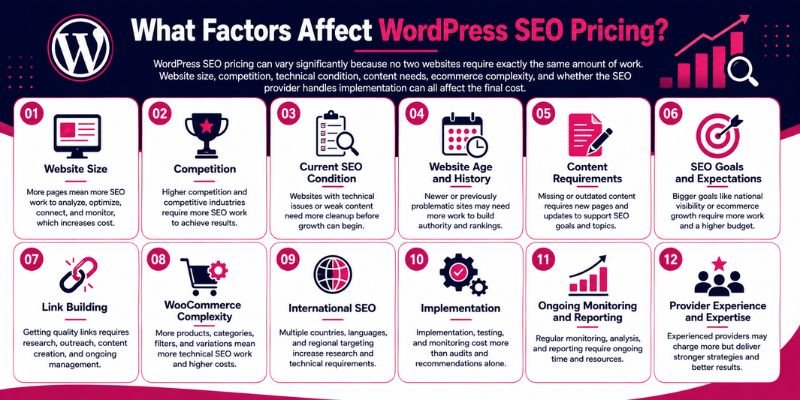
WordPress SEO pricing can vary significantly because no two websites require exactly the same amount of work. Website size, competition, technical condition, content needs, ecommerce complexity, and whether the SEO provider handles implementation can all affect the final cost. The factors below help explain why one website may need a small SEO budget while another requires a much larger campaign.
Website Size
The more pages a website has, the more SEO work may be needed to analyze, optimize, connect, and monitor them, which can increase the overall SEO cost. Larger websites can also have more indexing problems, duplicate pages, thin content, internal-linking issues, and technical errors.
For example, an SEO provider may need to work on:
- Indexing problems
- Duplicate pages
- Thin or outdated content
- Internal linking
- Technical SEO issues
A 10-page website usually requires much less SEO work than a site with hundreds or thousands of URLs, so website size can directly affect the SEO budget.
Competition
The more competitive your target search terms are, the more SEO work may be needed to compete. SEO costs can increase when you compete for highly competitive keywords. A local business targeting a low-competition search may need less SEO work, while a national website competing against established sites may need more content, technical optimization, and link building.
Your industry can also affect SEO costs because some markets are more competitive than others. A local business in a less competitive niche may need less SEO work, while industries such as finance, healthcare, legal services, or competitive ecommerce may require more content, technical optimization, and link building to compete.
Current SEO Condition
The current condition of your website can change how much SEO work is needed. A website with a clean structure, healthy indexing, and well-optimized pages may only need gradual improvements. A site with technical problems, poor internal linking, duplicate pages, or weak content may need more cleanup and implementation before the SEO campaign can focus on growth.
For example, an SEO provider may need to fix:
- Indexing problems
- Broken links or redirects
- Duplicate pages
- Poor internal linking
- Slow or poorly optimized pages
- Weak or outdated content
Website Age and History
A website’s age and SEO history can affect how much work is needed. A newer website usually has fewer established rankings, backlinks, and search data to build on, while an established site may already have useful content and organic visibility. Previous migrations, redesigns, technical problems, or poor SEO practices can also increase the amount of cleanup required.
For example, an SEO provider may need to review:
- Previous website migrations
- Old or broken URLs
- Existing backlinks
- Current search rankings
- Indexing problems
- Previous SEO changes
Content Requirements
The amount of content your website already has can affect the cost of SEO. If your existing pages are useful and well-structured, an SEO provider may mainly update and optimize them. If important topics or pages are missing, the campaign may also need new content to cover those searches and support the site’s overall SEO strategy.
This may include:
- Service pages for the products or services you offer
- Product content for ecommerce websites
- Blog articles that answer relevant customer questions
- Location pages for businesses targeting specific cities or areas
- Comparison content for users researching different options
- Supporting topical content that covers related questions and strengthens the main topic
SEO Goals and Expectations
Your SEO goals can also affect the amount of work and budget required. Improving a few existing rankings may require less work than building organic traffic for a new website, targeting a national market, or growing an ecommerce store.
Your SEO goals might include:
- Improving existing rankings
- Generating local leads
- Increasing ecommerce sales
- Building national organic traffic
- Recovering from a ranking or traffic decline
Link Building
Link building means getting relevant links from other websites that can help people discover your content and can contribute to your website’s overall authority. The cost can increase when an SEO provider needs to research suitable websites, create content, contact site owners, review opportunities, and manage outreach.
The work may include:
- Finding relevant websites
- Researching link opportunities
- Creating content for placements
- Outreach to website owners
- Reviewing websites before pursuing a link
- Monitoring and managing outreach campaigns
WooCommerce Complexity
WooCommerce websites can require more SEO work because online stores often have many products, categories, filters, and URLs to manage. A small store with a simple structure may need only basic product and category optimization, while a large store can require more technical work to control duplicate URLs, indexing, product variations, and site structure.
Depending on the store, SEO work may involve:
- Product variations – different sizes, colours, or other versions of the same product
- Categories – organizing products into useful, searchable groups
- Filters – options that let shoppers narrow products by price, size, brand, colour, and more
- Faceted navigation – filter combinations that can create many extra URLs
- Product schema – structured data that helps search engines understand product information
- Large numbers of URLs – thousands of product, category, filter, or variation pages
- Out-of-stock products – deciding how unavailable products should be handled in search
A 20-product WooCommerce store usually requires much less SEO work than a store with thousands of products, so the size and complexity of the catalogue can directly affect the SEO budget.
International SEO
International SEO becomes more involved when a website targets customers in multiple countries or languages. The SEO strategy may need to account for different search terms, languages, locations, and versions of the website. This can increase the amount of research and technical work required.
It may include:
- Hreflang to help search engines understand language and regional versions
- Regional keyword research for how people search in each target market
- Localized content adapted to each country or language
- International technical SEO for managing multiple versions of the site
- Country-specific performance analysis to see how each market is performing
Implementation
The final SEO cost can increase when the provider is responsible for actually making and testing the recommended changes, rather than only identifying them. For example:
- $700: SEO audit and recommendations
- $1,200: Audit, implementation, testing, and monitoring
The second option costs more, but you won’t need to hire someone else to implement the SEO work.
Before hiring an SEO provider, ask whether implementation is included in the quoted price.
How Much Does WordPress Technical SEO Cost?
Technical SEO pricing varies widely depending on website size and complexity.
A small audit can cost a few hundred dollars, while more extensive audit-and-implementation work can reach several thousand dollars.
The factors that tend to increase technical SEO scope include:
- Large numbers of URLs
- WooCommerce
- Multilingual websites
- JavaScript-heavy functionality
- Complex schema
- Website migrations
- Indexation problems
- Custom development
- Developer implementation
You should also distinguish between audit-only and implementation.
An audit tells you what is wrong.
Implementation means someone actually fixes the problems and verifies the changes.
For a complicated WordPress website, implementation can require both SEO and development skills.
How Much Does WooCommerce SEO Cost?
WooCommerce SEO can cost more than SEO for a small service website because ecommerce sites often have more pages and more complicated structures.
Work may include:
- Product page optimization
- Category optimization
- Product schema
- Product variations
- Filters
- Faceted navigation
- Ecommerce keyword research
- Product and category content
- Internal linking
- Indexation controls
- Technical performance
A 20-product store and a 5,000-product store should not receive the same SEO quote.
The number of products, category structure, filters, competition and technical setup all affect the workload.
Does a Higher SEO Budget Mean Faster Results?
Not necessarily.
A larger budget allows more work to be completed, but rankings still depend on:
- Competition
- Website history
- Content quality
- Search intent
- Technical health
- Authority
- Existing rankings
- Search demand
Increasing a budget from $500 to $2,000 may allow more pages to be optimized and more content to be produced, but it doesn’t guarantee that Google will move those pages to the top of the results immediately.
Be cautious of anyone connecting a specific payment amount with a guaranteed ranking date.
A legitimate SEO provider should explain:
- What will be done
- What will be measured
- What depends on your team
- What may take longer
- How the strategy will change based on results
Can You Do WordPress SEO Yourself?
Yes. For a small website, DIY SEO can be a practical choice.
You can start with:
- Google Search Console
- Keyword research
- Title optimization
- Meta descriptions
- Internal linking
- Image optimization
- Content updates
- Basic technical checks
- Performance monitoring
DIY SEO becomes harder when the website is large, the competition is strong, or the work requires significant technical implementation and ongoing content or link acquisition.
The highest cost of DIY SEO isn’t always money.
It’s time.
If you spend several hours every week learning SEO, analyzing competitors, creating content, fixing technical problems and tracking performance, that time has a real value as well.
Is an SEO Plugin Enough?
No. An SEO plugin is a tool, not a complete SEO strategy.
| An SEO plugin can help with | It doesn’t replace |
| Meta titles | Keyword strategy |
| Meta descriptions | Competitor analysis |
| XML sitemaps | Search-intent analysis |
| Schema | Content strategy |
| Redirects | Link-building strategy |
| Basic on-page checks | SEO decision-making |
SEOPress, for example, currently offers features including site audits, local SEO, WooCommerce SEO, schema, XML sitemaps and redirect management. Its Pro license starts at $49 per year for one site.
But the plugin doesn’t decide:
- Which pages deserve optimization
- Which keywords are commercially valuable
- Why another site outranks you
- Which content is missing
- Which internal links to add
- Which backlinks are worth pursuing
The software supports the work. It doesn’t replace the strategy.
Freelancer vs SEO Agency: Which Costs Less?
A freelancer will often cost less than an agency because the delivery model involves fewer people and less overhead.
Ahrefs’ survey found average monthly retainers of approximately $1,348 for freelancers and $3,209 for agencies.
| Freelancer | SEO agency |
| Usually lower cost | Usually higher cost |
| Direct communication | Account/project management |
| Often one main specialist | Multiple specialists |
| Good for focused projects | Useful for broad campaigns |
| Flexible scope | More structured processes |
| Smaller overhead | Wider team and resources |
A freelancer may be a better fit when:
- Your website is small
- Your needs are focused
- Your budget is limited
- You need direct communication
- You need one specialist
An agency may make more sense when:
- You require technical SEO + content creation and link building
- Your website is large
- You’re competing nationally
- You need several specialists
- Organic search is a major acquisition channel
The goal isn’t to choose the cheaper provider.
It’s to choose the delivery model that matches the work.
How to Compare WordPress SEO Quotes
When comparing SEO proposals, don’t look at the monthly price alone. Check what work is included, how much work will be done, who handles implementation, and what you’ll receive in return.
What exactly is included?
Get the deliverables in writing so you can compare one proposal with another.
How many pages will you optimize?
“On-page SEO” could mean five pages or 100 pages. Ask how many pages are included and which pages will be prioritized.
Is content included?
Find out whether the provider will write new content, update existing pages, or only give recommendations.
Are technical fixes included?
Some providers identify technical problems but leave the implementation to you or your developer. Confirm who will actually make the fixes.
Is link building included?
Ask how links will be acquired, what types of websites will be targeted, and whether the provider handles the outreach.
What happens during the first month?
The first month may focus on auditing, keyword research, technical setup, and planning before larger optimization work begins.
What will you receive each month?
Ask for a clear report showing completed work, organic traffic, rankings, conversions, and the next planned tasks.
Is there a minimum contract?
Check whether you must commit for three, six, or twelve months and what the cancellation terms are.
What happens if you cancel?
Find out what happens to your content, reports, analytics accounts, tracking setup, and other SEO assets after the contract ends.
How is success measured?
A good SEO provider should measure meaningful outcomes such as organic traffic, qualified leads, conversions, and ranking improvements rather than promising a specific Google position.
Is Cheap WordPress SEO Worth It?
Sometimes. A low-cost SEO project can work when:
- The website is small
- Competition is limited
- The scope is narrow
- You mainly need foundational work
The problem is when a provider promises an unrealistic amount of work for an extremely low price.
For example:
$99/month – unlimited keywords, 100 backlinks, 20 articles and guaranteed page-one rankings
That’s a very different offer from:
$300 one-time – technical SEO audit with prioritized recommendations
The second may be perfectly reasonable because the scope is clear.
So the real question isn’t:
“Is this SEO package cheap?”
It’s:
“Does the price fair for the work that is being promised?”
How Much Should a Small Business Budget for WordPress SEO?
For many small businesses, $500–$1,500 per month is a practical starting range for ongoing WordPress SEO. Smaller websites with low competition may need less, while competitive national businesses, larger websites, or WooCommerce stores may need a larger budget.
The right budget depends on:
- Website size: A 10-page service website has very different needs from a 300-page ecommerce site.
- Competition: A local niche may require less ongoing work than a competitive national search market.
- Current website condition: Technical problems can increase the initial workload.
- Internal resources: If you can write content and implement WordPress changes yourself, you may need less external support.
- Business value: A business that generates substantial revenue from organic leads can justify a larger SEO investment than a hobby website.
A smaller site may need less. A competitive national business may need more.
The goal is to pay for the amount of SEO work your website actually needs, not simply choose the lowest monthly price.
A Simple WordPress SEO Budget Framework
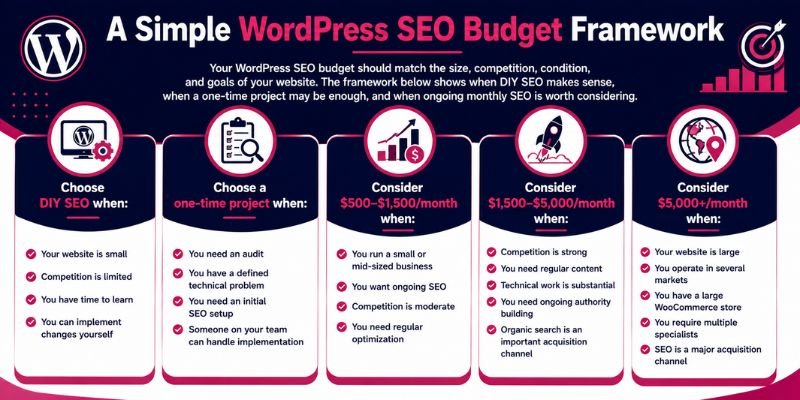
Your WordPress SEO budget should match the size, competition, condition, and goals of your website. The framework below shows when DIY SEO makes sense, when a one-time project may be enough, and when ongoing monthly SEO is worth considering.
Choose DIY SEO when:
- Your website is small
- Competition is limited
- You have time to learn
- You can implement changes yourself
Choose a one-time project when:
- You need an audit
- You have a defined technical problem
- You need an initial SEO setup
- Someone on your team can handle implementation
Consider $500–$1,500/month when:
- You run a small or mid-sized business
- You want ongoing SEO
- Competition is moderate
- You need regular optimization
Consider $1,500–$5,000/month when:
- Competition is strong
- You need regular content
- Technical work is substantial
- You need ongoing authority building
- Organic search is an important acquisition channel
Consider $5,000+/month when:
- Your website is large
- You operate in several markets
- You have a large WooCommerce store
- You require multiple specialists
- SEO is a major acquisition channel
How to Find the Right WordPress SEO Service for Your Budget
The right WordPress SEO service depends on your website size, competition, SEO needs, and budget. A small website may be better suited to DIY SEO or a focused freelancer, while a competitive business, large website, or WooCommerce store may need ongoing support from an experienced SEO provider. Don’t choose based on price alone; compare the scope of work, experience, implementation, reporting, and results you can reasonably expect.
Once you understand SEO pricing, the next step is matching the provider to your actual needs.
Don’t begin by asking:
“Who is the cheapest?”
Start with:
“What does my website actually need?”
Then compare providers based on:
- WordPress SEO experience
- Technical SEO ability
- Content expertise
- Link-building approach
- WooCommerce experience, if relevant
- Reporting
- Communication
- Contract terms
- Case studies
- Actual deliverables
Before comparing specific providers, you can also see our guide to 20 Affordable WordPress SEO Companies in the USA.
That guide has a different purpose: it compares companies, pricing and use cases, while this article focuses on understanding WordPress SEO costs and evaluating SEO quotes.
Final Thoughts
If you’re still questioning, “How much does WordPress SEO cost?”, there is no set pricing that fits every website. You can handle the basics yourself, pay for a one-time audit, hire a freelancer for specific work, or invest several thousand dollars each month in an ongoing campaign.
The price of WordPress SEO services only makes sense when you understand the work behind it. A $500 package can be a good fit for one website and completely inadequate for another. A $3,000 package may be reasonable when it includes technical implementation, content, link building, and ongoing strategy, but unnecessary for a small website that only needs foundational SEO.
Before choosing an SEO provider, ask four questions:
What needs to be done?
Who will do it?
What exactly is included?
How will the work be measured?
Those answers will tell you much more than the monthly price alone.
FAQs About WordPress SEO Cost
WordPress SEO can cost around $500–$5,000+ per month for ongoing professional services, depending on the website, competition, and scope of work. For many small businesses, $500–$1,500 per month can be a practical starting range.
SEO pricing varies widely. You may spend $0 with DIY SEO, a few hundred to several thousand dollars for a one-time project, or $500–$5,000+ per month for ongoing professional SEO. Larger and more competitive websites can require higher budgets.
Basic SEO can be done for free, using tools such as Google Search Console and free SEO plugins. However, professional SEO involves time, strategy, content, technical work, monitoring, and sometimes paid tools or link-building services.
The right budget depends on your website size, competition, current SEO condition, and the amount of work you need. A small business may start around $500–$1,500 per month, while larger or more competitive websites may need a higher budget.
$500 can be enough for a small, focused SEO campaign when the website has limited competition and a clearly defined scope. It is unlikely to cover every SEO service for a large or highly competitive website.
Many small businesses can start with $500–$1,500 per month for ongoing SEO, although some websites may need less or more. The final cost depends on website size, competition, technical condition, content needs, and the work included in the package.
SEO itself doesn’t have to require a large budget. You can handle basic SEO yourself for little or no software cost, but professional services require payment for research, implementation, content, technical work, monitoring, and strategy.
There is no calculator that can accurately price every WordPress SEO campaign because each website has different requirements. A better estimate comes from considering website size, competition, technical condition, content needs, and the amount of work the provider will handle.
No. An SEO plugin can help with tasks such as titles, meta descriptions, sitemaps, schema, and redirects, but it doesn’t replace keyword research, competitor analysis, content strategy, technical decision-making, or link building.
It can. WooCommerce stores often have more products, categories, variations, filters, and URLs to manage. A small store may need a limited SEO campaign, while a large catalogue can require more technical, content, and ecommerce SEO work.
There is no fixed timeframe for SEO results. Competition, website history, technical condition, content quality, authority, and the amount of work being done all affect how quickly rankings can improve. A larger budget can increase the amount of work completed, but it cannot guarantee a specific ranking or timeframe.
Yes. DIY SEO can work well for small websites with limited competition if you have time to learn and implement the work. Professional help becomes more useful as the website grows, competition increases, or technical and content requirements become more complex.
A freelancer can be a good fit for a small website or focused project, while an agency may make more sense when you need several specialists or a broader SEO campaign. Compare the experience, scope, communication, and deliverables rather than choosing only by price.
Ask what work is included, how many pages will be optimized, whether content and technical implementation are covered, how links are acquired, what reporting you’ll receive, whether there is a minimum contract, and how success will be measured.




- Be Respectful
- Stay Relevant
- Stay Positive
- True Feedback
- Encourage Discussion
- Avoid Spamming
- No Fake News
- Don't Copy-Paste
- No Personal Attacks
- Be Respectful
- Stay Relevant
- Stay Positive
- True Feedback
- Encourage Discussion
- Avoid Spamming
- No Fake News
- Don't Copy-Paste
- No Personal Attacks
